
Executive Transition Programme
Your Track Record Came With You. The Conditions That Built It Didn’t.
Structured first-year transition support for leaders stepping into a new or significantly expanded role.
Every transition is different. The programme is shaped to the executive, not sold as a fixed block.

EXECUTIVE TRANSITION.
Building the conditions for success.
Why the first year is different
And the organisation is not waiting while you rebuild them.
Proven capability. Sound judgement. Credibility. A track record of delivering results. What often goes underestimated is how much of that success was enabled by conditions that no longer exist in a new environment.
What no longer comes with them
- Established trust
- Stakeholder relationships
- Contextual knowledge
- Organisational familiarity
- Confidence
- Support structures built over years
Yet expectations arrive immediately
- The organisation expects momentum
- Stakeholders expect clarity
- Teams expect leadership
- Boards expect outcomes
Up to 18 months to rebuild it.
90 days to prove it.
The programme exists to rebuild those conditions deliberately, at the pace the role actually demands, rather than leaving them to chance across a first year you only get once.
What you are getting
Five things that hold, well beyond the first 90 days.
A confidential thinking partner
Dedicated space throughout the year to step out of the pressure, challenge your own assumptions, and work through not just what to do, but who to be as a leader in this new context.
Credibility and stakeholder trust
Established early and deliberately, rather than left to chance.
A leadership team aligned behind you
Committed to a shared direction, not quietly waiting to see whether you last.
Visible, meaningful momentum
Progress that builds confidence without burning the trust you will need later.
Effectiveness that holds under pressure
Not a fast start that fades, but a foundation that carries into year two.

The thread through the whole programme
A genuine thinking partner.
The framework, structure and tools provide the discipline. But an equally important part of the value is the thinking partnership itself: confidential, dedicated thinking space with someone entirely focused on your agenda.
It lets you step out of the pressure around you, think through what your situation really means, test and challenge your own assumptions, and decide what to do, when to act, and what to leave alone, with greater clarity, objectivity and confidence.
Increasingly, it is also about more than what do I need to do. It is about who do I need to be, and how do I need to show up as a leader in this environment.
The programme
Typically a 12-month programme, beginning with a six-month commitment.
WHO IT IS FOR
Leaders in the first year of a new or significantly expanded role, where the expectations arrive immediately but the conditions for success still have to be rebuilt.
for the initial six months
HOW THE ENGAGEMENT IS STRUCTURED
- First, we agree the anticipated duration. At the outset we agree how long your programme is likely to run, based on where you are in your transition and what you need. Typically this is a 12-month programme, though it may be shorter if you are already further in.
- You commit to and pay for the first six months. This covers the phases where the work is most intense: understanding the context, clarifying the mandate, and building early trust and momentum before expectations harden.
- At six months, we review progress and the value of continuing. If we agree to continue, you recommit for the remaining period agreed at the outset. For a 12-month programme that would normally mean a further six months.
- Throughout, the intensity flexes with the role. We review progress, priorities and the value you are getting as we go, adapting the focus and cadence as your transition evolves. Some months demand close, frequent support. Others need far less.
- At the end of the agreed programme, we look at what comes next. Whether there is value in continuing to work together beyond the transition itself.
WHAT IS INCLUDED THROUGHOUT
- The seven-phase framework. A structured programme built on a proven executive transition method, with phases that follow the shape of a real transition rather than a fixed calendar.
- Structured reflection at each phase. Across the Five Cs, executive energy, and the common derailers that quietly undo capable leaders.
- Coaching and thinking partnership. To interpret complexity as it emerges, rather than after it has cost you.
- Stakeholder and mandate calibration. Plus leadership-team support, to build alignment early.
Every engagement begins with a conversation, so the shape of the journey is agreed before anything starts. A confidential-only version, without the organisational interventions, is available where an engagement needs to stay entirely private.
The economics of executive transition
What is actually at stake, set against the investment.
The figures below are illustrative, based on an executive earning $250,000 a year. They are not a promise of return. They are there to give the investment a sense of scale.
Protect Executive Career Value
For an executive earning $250,000 annually, six months spent securing the next role represents approximately $125,000 in foregone base salary alone. That is before taking account of bonus, pension or retirement contributions, equity and other benefits. Making the right transition, and increasing the likelihood of making it successfully, protects significant personal career value.
Assumption: $250,000 annual base salary ÷ 2 = $125,000 for six months.
Accelerate Organisational Value
Executive transition support can accelerate the journey to break-even and effective contribution. For an executive earning $250,000 annually, bringing that point forward by three months represents approximately $62,500 of salary investment brought forward, before considering the wider organisational value created through earlier decisions, stronger alignment and faster executive effectiveness.
Assumption: $250,000 annual base salary ÷ 4 = $62,500 for three months. Illustration assumes a three-month acceleration in time to impact.
Sources: Russell Reynolds Associates; Michael Watkins, The First 90 Days.
Protect Organisational Value
An unsuccessful executive appointment can carry a cost many times greater than salary alone, through recruitment and replacement costs, lost momentum, disrupted teams, delayed decisions and wider organisational impact. Using the conservative estimate of 6x annual salary, a $250,000 executive appointment represents potential organisational exposure of $1.5 million or more.
Assumption: $250,000 annual base salary × 6 = $1.5 million. Deliberately uses the conservative end of the estimated range.
Sources: Melanie Hughes, Forbes; Michael Watkins, The First 90 Days.
Set against $9,000 for the initial six months of the Executive Transition Programme.Every transition is different, and no engagement can guarantee an outcome. The figures above are there to frame the decision, not to predict it.
How the work is structured
Seven phases, from before day one to sustained effectiveness.
Built on the Double Diamond, licensed via the Certified Transition Coach™ methodology.
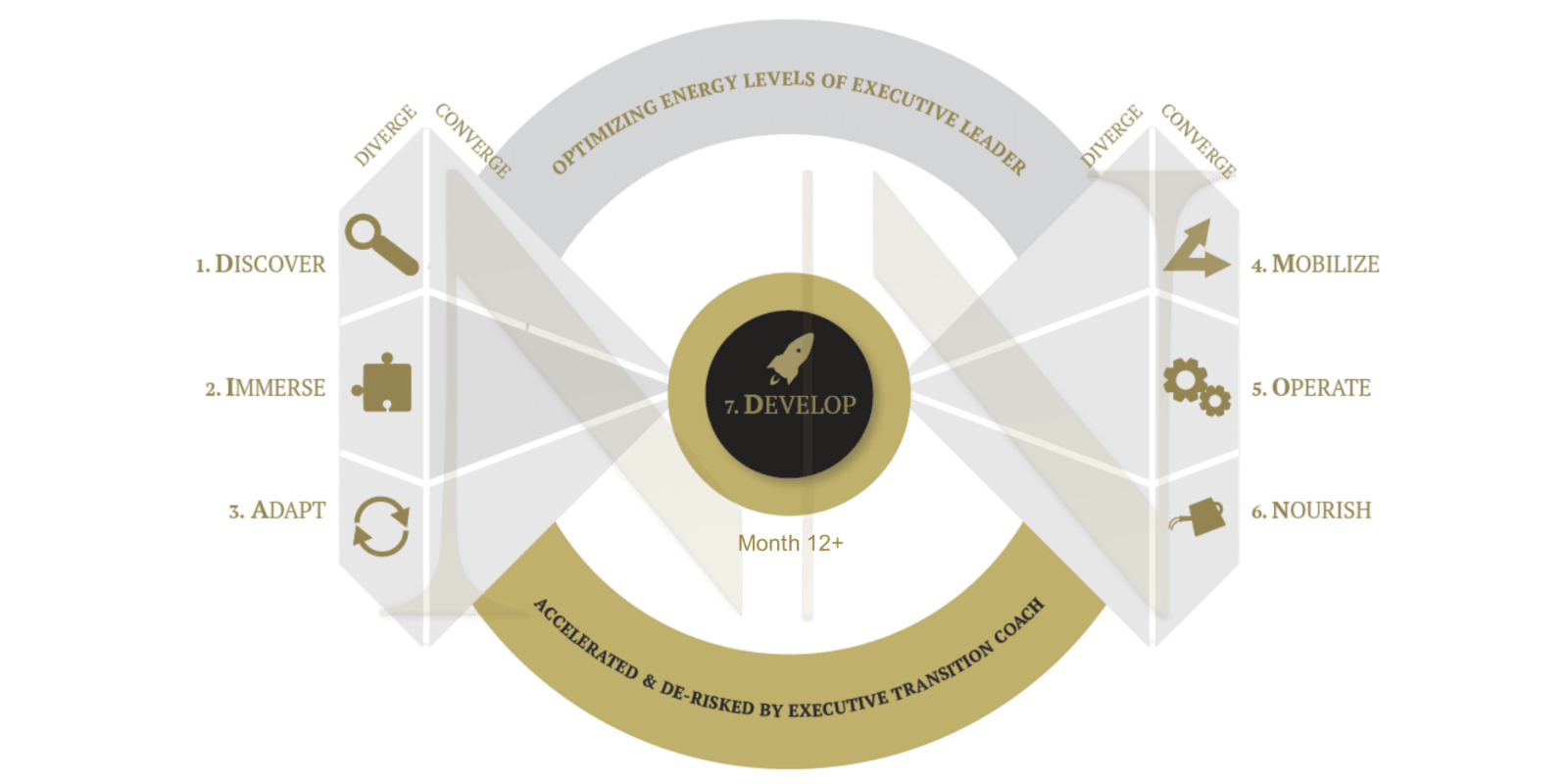
The Double Diamond Framework© of Executive Transitions.
Discover
Before day one
Immerse
The early months in role
Adapt
Approx. months 3 to 4
Mobilise
Approx. months 4 to 6
Operate
Approx. months 6 to 9
Nourish
Approx. months 9 to 12
Develop
From around month 12
Executive energy
Optimised across every phase
The phases always follow in sequence, but their length varies with the executive, the organisation and the transition context. The timings above are indicative rather than fixed.
- Structured reflection at each phase, across the Five Cs, executive energy, and the common derailers that quietly undo capable leaders.
- Coaching and thinking partnership to interpret complexity as it emerges.
- Stakeholder and mandate calibration, and leadership-team support, to build alignment early.
What the programme rebuilds
The Six Conditions for Executive Transition Success.
These are the conditions that determine whether a senior leader succeeds in a new role. The programme rebuilds each one deliberately, and the free assessment scores you against the same six.
Transition Context
The structural context surrounding your leadership role and the organisational conditions shaping your transition.
Mandate Clarity
How clearly expectations for your role, priorities, and measures of success are aligned across the organisation.
Stakeholder Trust
The level of trust and alignment between you and the senior stakeholders whose confidence shapes your authority.
Leadership Team Alignment
The capability and cohesion of the leadership team surrounding you and their ability to support the transition.
Early Organisational Momentum
Your ability to generate visible progress and credibility during the early phase of the role.
Sustained Effectiveness
Your ability to maintain influence, clarity, and resilience as the transition evolves over time.

What leaders say
Feedback from leaders Natalie has worked with.
Working with Natalie helped me navigate a significant leadership transition as the organisation entered its next phase of growth and I needed to shift from being closely involved in operations to leading more strategically. Through our work, I clarified my mandate, strengthened alignment with my leadership team and built trust with key stakeholders. I moved from reacting to increasing demands and being involved in everything to leading more deliberately and creating the conditions for others to lead.
Working with Natalie as I prepared for and transitioned into a new role helped me anticipate potential headwinds and approach the challenges ahead in a much more structured way. Exploring my own personality and those of others gave me a fresh perspective on how I interact and build relationships with a new team, while Natalie helped me develop practical tools to manage the transition. Her approach is professional, flexible and focused on ensuring the coaching continually adapts to where it can add most value.
Working with Natalie as I transitioned from senior leadership into executive leadership challenged my thinking, broadened my perspective, and helped me develop the strategic thinking and self-awareness I needed for the next stage of my career. There is a real gap in preparing leaders for executive-level roles, and working with Natalie provided a form of leadership development I simply wouldn’t have gained through more traditional routes. The difference for me has been remarkable. I’m no longer just surviving, I genuinely feel like I’m thriving, and a huge part of that is down to Natalie’s support, guidance, and encouragement.
Why Natalie Simms
She has lived these transitions.
- Four executive transitions personally navigated, including one that nearly derailed her.
- Former Group CTO at Condé Nast, leading transformation across 11 international markets, and International CIO at Disney.
- Certified Transition Coach™, ICF-credentialed, with postgraduate study in Digital and AI Leadership at Imperial College Business School.
- Based in the UK, working with executives internationally. Programme fees are quoted in US dollars.
“I’ve lived these transitions, not simply observed them.”
The first year is the one you only get once.
Book a call and we will work out the right shape for your transition together.
The starting point is always a conversation. The journey is tailored to where you actually are.

Executive Transition Programme with Natalie Simms.
© 2026 Natalie Simms | Privacy